Bile duct problems can affect digestion, liver function, and overall health. Conditions such as bile duct stones, narrowing of the bile ducts, injuries following gallbladder surgery, and bile duct tumours may interfere with the normal flow of bile from the liver to the intestine. Depending on the underlying cause and severity, treatment may involve medication, endoscopic procedures, or surgery.
Dr. Dinesh Ramaswamy provides surgical evaluation and treatment for hepatobiliary and gastrointestinal conditions. Patients experiencing persistent jaundice, recurrent bile duct infections, or a diagnosed bile duct abnormality can undergo a detailed assessment to understand their condition and available treatment options.
The appropriate treatment depends on the diagnosis, the location of the blockage or injury, the condition of the liver, and the patient’s overall health. Early evaluation can help identify complications and guide timely medical care.
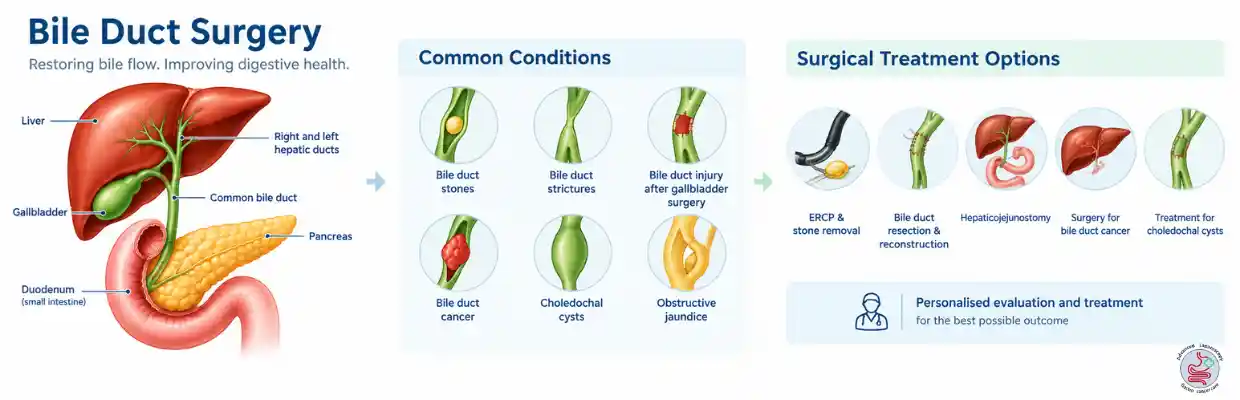
Bile duct surgery involves procedures to remove blockages, treat damaged sections of the bile ducts, or restore the normal passage of bile. The bile ducts are a network of small tubes that carry bile from the liver and gallbladder to the small intestine, where it helps digest fats.
When a bile duct becomes blocked, narrowed, injured, or affected by a tumour, bile may accumulate in the liver. This can lead to jaundice, itching, abdominal discomfort, infection, and, in prolonged cases, liver damage.
Not every bile duct condition requires an operation. Some problems can be managed through endoscopic treatment, such as ERCP (endoscopic retrograde cholangiopancreatography), which can help remove stones or place a stent to improve bile flow. Surgery may be necessary when these approaches are unsuitable or when the condition requires reconstruction or removal of affected tissue.
Treatment is selected according to the cause of the problem and its effect on bile drainage.
Stones can develop in the common bile duct and obstruct the flow of bile. Some patients experience abdominal pain, nausea, or jaundice, while others may develop an infection known as cholangitis.
ERCP is often used to remove common bile duct stones. Surgery or additional procedures may be considered if the stones cannot be removed endoscopically, recur, or are associated with other complications.
A bile duct stricture is an abnormal narrowing that restricts the passage of bile. It may occur following surgery, inflammation, injury, or certain diseases affecting the bile ducts.
Treatment depends on the location and severity of the narrowing. Options may include endoscopic dilation, stent placement, or surgical reconstruction to establish adequate bile drainage.
The bile ducts can occasionally be injured during gallbladder removal. Such injuries may cause bile leakage, obstruction, abdominal pain, fever, or jaundice.
Management depends on the type and extent of the injury. Some cases can be treated endoscopically, while more complex injuries may require reconstruction of the bile duct. Timely assessment by an experienced hepatobiliary surgical team is important when a significant injury is suspected.
Bile duct cancer, also called cholangiocarcinoma, develops in the cells lining the bile ducts. Symptoms may include jaundice, dark urine, pale stools, itching, and unexplained weight loss, although symptoms vary depending on the tumour's location.
Treatment depends on the cancer's location, stage, and whether it can be removed safely. Surgery may involve removing the affected bile duct, nearby tissues, or part of the liver. Other treatments, including systemic therapy, may be recommended depending on the individual case.
Choledochal cysts are abnormal dilatations of the bile ducts that are often present from birth. They may cause abdominal pain, jaundice, pancreatitis, or recurrent bile duct infections.
Surgical removal of the affected portion of the bile duct, followed by reconstruction, is commonly recommended for suitable patients because these cysts can lead to recurrent complications and an increased risk of cancer over time. The procedure and timing depend on the cyst's anatomy and the patient's condition.
Obstructive jaundice occurs when bile cannot flow normally from the liver into the intestine. Causes include stones, strictures, inflammation, and tumours.
The first step is to identify and treat the underlying cause. Depending on the diagnosis, treatment may involve ERCP, biliary drainage, stenting, or surgery. Jaundice itself does not automatically mean that an operation is required.
Bile duct conditions may initially cause mild symptoms, but some can progress and require urgent treatment. Medical evaluation is recommended if you experience:
Seek urgent medical attention if jaundice occurs with fever, chills, or significant abdominal pain. These symptoms may indicate a bile duct infection or another serious condition that requires prompt assessment.
The choice of procedure depends on the affected area, the underlying disease, and whether the goal is to remove a blockage, repair an injury, or treat a tumour.
When stones remain in the common bile duct, they are often removed through ERCP. Surgical exploration may be considered when endoscopic removal is unsuccessful or unsuitable, or when another operation is required at the same time.
If a section of the bile duct is severely narrowed, damaged, or affected by disease, the surgeon may remove the affected portion and reconnect the remaining bile duct to restore bile flow. The exact technique depends on the location and extent of the abnormality.
Hepaticojejunostomy is a reconstructive procedure in which the bile duct or the bile drainage opening near the liver is connected to a section of the small intestine. It may be performed to treat selected bile duct injuries, complex strictures, or after removal of diseased bile duct tissue.
For selected patients with resectable bile duct cancer, surgery aims to remove the tumour with appropriate surrounding tissue. Depending on the tumour's location, this may involve bile duct removal, liver resection, and assessment of nearby lymph nodes.
Not every bile duct cancer can be treated with surgery. Imaging, staging, liver function, and overall fitness must be assessed before a treatment plan is established.
Surgical treatment commonly involves removing the abnormal bile duct segment and creating a new route for bile to drain into the intestine. The operative approach is based on the type of cyst and its relationship to nearby structures.
Accurate diagnosis helps determine whether a patient needs medication, endoscopic treatment, drainage, or surgery. The evaluation may include:
Not every patient requires all these investigations. The specialist recommends tests according to the symptoms, examination findings, and initial results.
Preparation depends on the planned procedure and the patient's medical condition. Before surgery, the treating team may:
For complex bile duct conditions, coordination between hepatobiliary surgeons, gastroenterologists, radiologists, anaesthesiologists, and other specialists may be necessary.
Recovery varies according to the type of procedure, the underlying disease, and the patient's general health. An endoscopic procedure may allow a quicker return to routine activities than major bile duct reconstruction or cancer surgery.
After an operation, the healthcare team monitors the patient's condition and looks for signs of complications.
Contact the treating team promptly if you develop fever, worsening abdominal pain, increasing jaundice, persistent vomiting, or unusual drainage from the surgical wound.
Bile duct conditions can involve the liver, gallbladder, pancreas, and surrounding blood vessels. Careful assessment is important to determine the safest and most appropriate treatment.
Dr. Dinesh Ramaswamy specialises in hepatopancreatobiliary (HPB) and gastrointestinal surgical care. Patients undergoing evaluation for a bile duct condition can discuss the diagnosis, the suitability of surgery, and available treatment approaches.
Key aspects of care include:
The recommended treatment and expected outcome depend on each patient's diagnosis and circumstances. A consultation helps clarify these factors before a treatment decision is made.
Persistent jaundice, recurrent bile duct infections, unexplained biliary obstruction, and suspected bile duct injuries should not be ignored. A specialist assessment can help identify the cause and determine whether endoscopic treatment, surgery, or another approach is appropriate.
Dr. Dinesh Ramaswamy provides consultations for hepatobiliary and gastrointestinal surgical conditions in Chennai. Bring any previous blood reports, ultrasound scans, CT or MRI images, ERCP reports, and discharge summaries to your appointment, if available.
To discuss your symptoms and treatment options, contact the clinic to arrange a consultation.
If you have been diagnosed with a bile duct disorder or are experiencing symptoms that may indicate biliary obstruction, seek a medical evaluation to understand the cause and available treatment options.
Coantact Dr. Dinesh Ramswamy's clinic in Chennai to discuss your condition and arrange an appointment.
It is complex but safe in expert hands. Modern imaging, refined techniques, and ICU-level care significantly reduce risks when performed by experienced hepatobiliary surgeons.
Early-stage bile duct cancer can be cured with complete surgical removal. Advanced cases may still benefit from surgery combined with chemotherapy, depending on evaluation.
Hospital stay typically ranges from 7–14 days. Full recovery may take several weeks, depending on the extent of surgery and underlying liver health.
Stay updated with expert insights, latest trends, and helpful articles.
Take the first step toward better digestive health. Book an appointment with our laparoscopy and gastroenterology team to receive expert care, clear guidance, and advanced minimally invasive solutions tailored to your needs.