
Understanding the Condition
What Exactly Is an Inguinal Hernia?
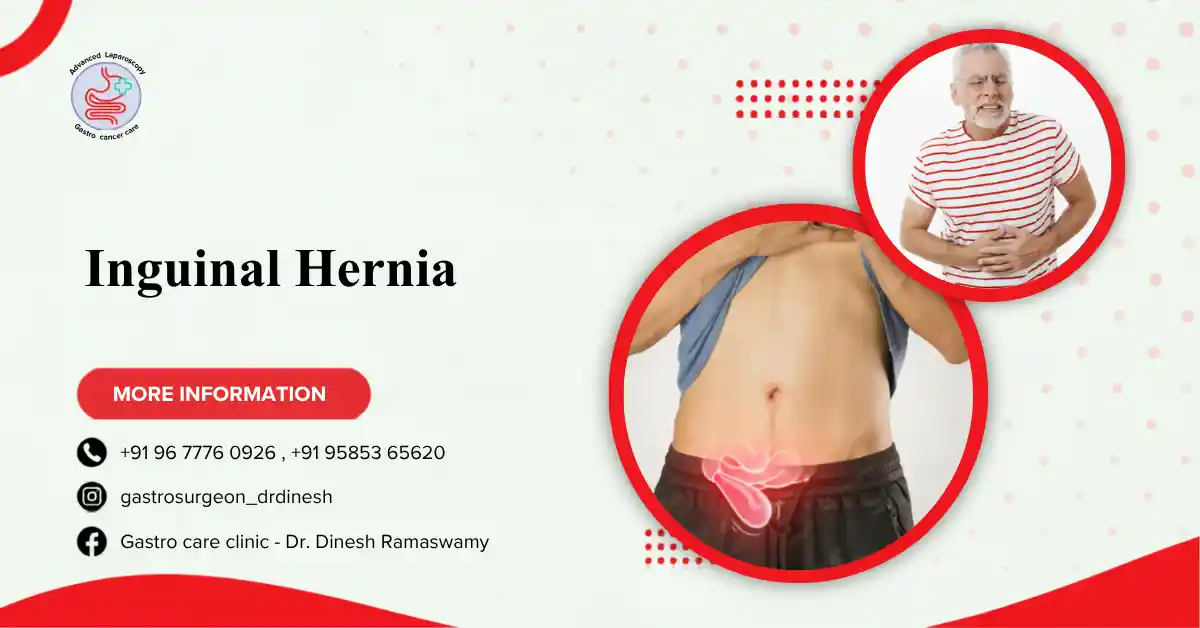
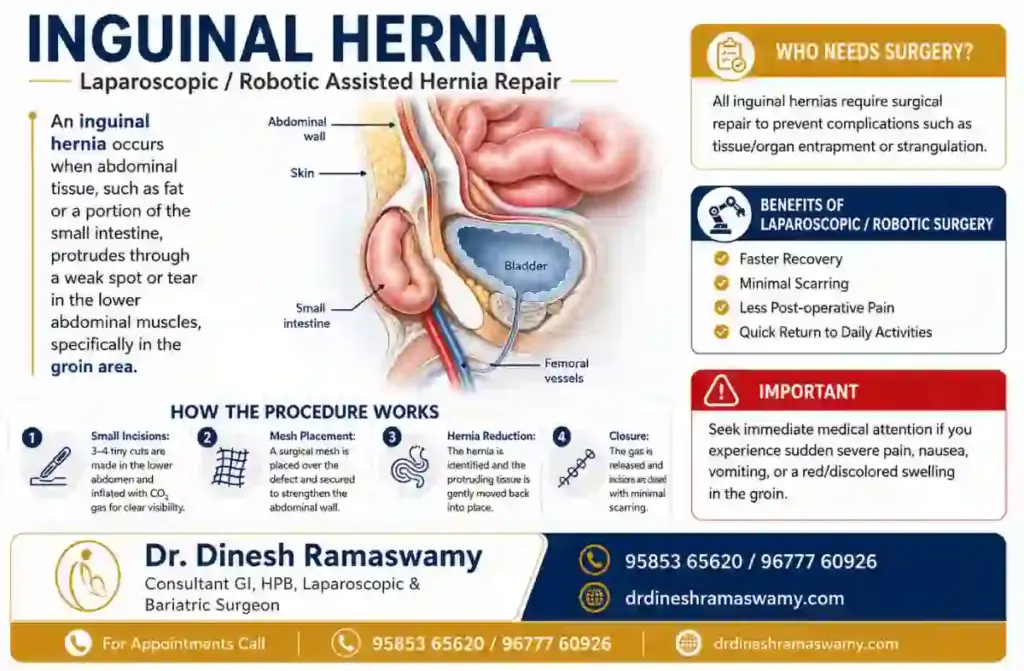
An inguinal hernia occurs when a portion of the abdominal contents — usually a loop of the small intestine or a pad of fatty tissue — pushes through a weak spot in the lower abdominal muscles into the groin area. This creates a visible or palpable bulge in the groin, and sometimes extends into the scrotum in men.
Inguinal hernias are among the most common surgical conditions worldwide. They are significantly more prevalent in men — approximately 10 times more so than in women — due to anatomical differences in the inguinal canal, a passage through which the spermatic cord travels in males.
Hernias do not heal on their own. Unlike a muscle strain or a cut on the skin, the defect in the abdominal wall cannot close without surgical repair. The opening tends to enlarge over time as intra-abdominal pressure continues to act upon it.
“A hernia is essentially a mechanical defect. No amount of rest, medication, or lifestyle change will close the gap in the abdominal wall. Surgery is the only definitive cure.”
Symptoms You Should Not Ignore
One of the most dangerous misconceptions about inguinal hernias is that if there is no pain, there is no urgency. Many patients live with a hernia for years, assuming that since it doesn’t hurt, it is not serious. This is incorrect — and potentially life-threatening.
Here is what to watch for:
- Groin Bulge: A lump in the groin or scrotum that may appear when standing, coughing, or straining, and disappear when lying down.
- Dragging Discomfort: heavy, pulling, or aching sensation in the groin — especially after prolonged standing or physical activity.
- Pressure or Weakness: feeling of pressure or weakness in the groin, often worsening towards the end of the day.
- Pain on Exertion: harp pain when bending over, coughing, or lifting objects.
- No Symptoms at All: any patients have an asymptomatic hernia — detected incidentally — that still carries a risk of future complications.
- Irreducibility: lump that was previously reducible (could be pushed in) becomes fixed and tender — a red flag requiring urgent attention.
Red Flag — Irreducible or Strangulated Hernia
If the hernia becomes stuck and cannot be pushed back, or if the overlying skin becomes red, shiny, or discoloured, the blood supply to the trapped organ may have been cut off. This is a strangulated hernia, which is a life-threatening emergency requiring immediate surgery. Do not delay — go to the nearest emergency department.
Why Surgery Is Almost Always Recommended
- A question I hear frequently in my clinic is: “Doctor, mine doesn’t hurt — why do I need surgery?” It is a fair question. The honest answer is that pain is a poor indicator of surgical urgency for hernias.
- The risk of a hernia is not pain — it is complication. Specifically, two serious events can occur:
The Two Complications That Demand Action
- Incarceration: The hernia becomes stuck in the groin canal and cannot be manually reduced. This causes obstruction of the intestine — resulting in severe pain, nausea, vomiting, and inability to pass gas or stools. Emergency surgery is then required, which carries significantly higher risks than a planned elective repair.
- Strangulation: The blood supply to the trapped intestine or tissue is cut off. Within hours, the tissue begins to die (gangrene), creating a surgical emergency. Mortality rates in strangulated hernias are far higher than elective repair — a stark reminder that timing matters enormously.
- Progression over time: Untreated hernias almost always enlarge. A small, manageable hernia today can become a large, complex one — making surgery technically more difficult and recovery longer.
- Impact on quality of life: Even a “painless” hernia often limits physical activity, affects work capacity, and creates ongoing psychological anxiety. Elective repair eliminates all of this.
Current international surgical guidelines recommend elective repair for most inguinal hernias — even in patients who are minimally symptomatic — precisely to prevent these unpredictable and dangerous complications. For patients who are young and fit, the risk of elective surgery is very low, and the benefit of avoiding a future emergency is substantial.
Laparoscopic & Robotic Hernia Repair: Surgery Reimagined
The biggest reason patients delay seeking treatment is the fear of surgery itself — fear of a large scar, a long hospital stay, severe pain, and weeks away from work and family. I understand this fear. But the surgery many people picture belongs to a different era.
Today, inguinal hernia repair is performed through minimally invasive techniques — laparoscopic or robotic-assisted surgery — that transform the entire experience. Here is how:
- Tiny Incisions (3–4 mm)Instead of a long open cut, 3 to 4 small keyhole incisions are made in the lower abdomen. The entire surgery is performed through these ports.
- Magnified VisualisationA high-definition camera (laparoscope) is inserted through one port, providing a magnified, illuminated view of the internal anatomy — far superior to the naked eye in open surgery.
- Hernia ReductionThe protruding tissue is gently and precisely moved back into the abdominal cavity, and the hernia defect is clearly identified.
- Mesh PlacementA lightweight, biocompatible surgical mesh is placed over the defect from behind the abdominal wall — providing strong, durable reinforcement that becomes integrated with the body’s own tissue over time.
- Closure with Minimal ScarringThe gas is released, instruments are withdrawn, and the small incisions are closed with absorbable sutures or skin glue. Most patients look down after surgery and struggle to even find the marks.
In robotic-assisted surgery, the surgeon controls a precision robotic platform (such as the da Vinci system) that offers even greater dexterity, three-dimensional vision, and wristed instrument movements impossible with the human hand. This is particularly valuable in complex, recurrent, or bilateral hernias.
How Does It Compare to Traditional Open Surgery?
| Parameter | Open Surgery | Laparoscopic / Robotic |
|---|---|---|
| Incision Size | 5–8 cm open cut | ✓ 3–4 tiny ports (3–5 mm) |
| Post-op Pain | Significant; narcotic use common | ✓ Minimal; managed with oral analgesics |
| Hospital Stay | 2–4 days | ✓ Day care / 23-hour admission |
| Return to Work | 4–6 weeks (desk job); longer for physical work | ✓ 7–14 days (desk); 3–4 weeks (physical) |
| Scarring | Visible scar | ✓ Barely visible marks |
| Bilateral Repair | Requires two separate incisions / operations | ✓ Both sides repaired in same operation |
| Recurrence Rate | Slightly higher | ✓ Equivalent or lower with experienced surgeon |
| Internal Vision | Limited to operative field | ✓ Magnified HD view of full anatomy |
What You Can Expect After Minimally Invasive Repair
- Walk the Same Day – Most patients are ambulant within hours of surgery
- Home Next Day – Day-care or overnight admission in the majority of cases
- Minimal Pain – Managed with simple oral analgesics — no heavy opioid
- Back at Your Desk in a Week – Most sedentary workers resume within 7–10 days
- Normal Activity by 4 Weeks – Including gym, swimming, and most physical work
- Virtually No Scar – Tiny marks that fade to near-invisibility within months
Don’t Let Fear — or the Absence of Pain — Keep You Away
In my years of practice as a GI and HPB surgeon, the patients I worry about most are not those who come in with a painful hernia — they are the ones who have had a hernia for two, five, or ten years, managing it with a truss or simply tolerating it, and then present to the emergency room in the middle of the night with a strangulation. That is when surgery becomes dangerous, recovery becomes prolonged, and lives are genuinely at risk.
Elective hernia repair today is safe, effective, and remarkably gentle on the body. With modern laparoscopic and robotic techniques, most patients are surprised by how straightforward the recovery is. The surgery takes approximately 30–60 minutes under general anaesthesia. You walk the same evening. You go home the next day. Most people return to routine activities within a week.
If you or a family member has been living with a groin bulge — whether painful or not — I encourage you not to delay. A timely consultation will give you clarity, allow us to plan an elective repair at your convenience, and protect you from the risk of an emergency that was entirely preventable.
“The best time to repair a hernia is now — when it is small, uncomplicated, and on your terms. Not at 2 AM in an emergency theatre when it is not.”